

In the 21st century, Real Madrid have always been the specter that hangs over the sport.
It's the club that almost everyone wants to play for because it's the club that has more money than everyone else. For the 2023-24 season, Madrid became the first club to ever record more than €1 billion in revenue, while the next richest were Manchester City down at a paltry €838 million.
A combination of institutional instability, impatience and an insatiable desire from president Florentino Perez to employ only the most famous players kept Madrid from ever truly turning their financial advantage into a Los Angeles Dodgers-like dominance.
But two years ago, it seemed as if it might happen.
In LaLiga, Madrid lost one game, finished with 95 points and led the league in both goals scored and conceded. In the UEFA Champions League, they took down Manchester City in penalties a year after being embarrassed by them in the semifinals, and although the subsequent semifinal with Bayern Munich went to extra time, Bavarians were the ones hanging on for dear life -- fortunate to squeak out a one-goal lead that quickly evaporated. Madrid won their 15th Champions League title with a 2-0 win over Borussia Dortmund.
Star forward Vinícius Júnior, then 23, finished second in Ballon d'Or voting, while a 19-year-old Jude Bellingham finished third and won LaLiga Player of the Year in his first season with the club. This was already the best team on the planet, and then it added perhaps the best player in the world as a 25-year-old Kylian Mbappé finally let his contract with Paris Saint-Germain run out.
Rather than paying for just-about-to-go-over-the-hill stars such as Eden Hazard, Real Madrid had begun to focus on outbidding everyone for the best young prospects (such as Vinícius), spending big on superstars just entering their primes (such as Bellingham), and persuading the prime-age established stars (such as Mbappe) to run out their contracts and join Madrid without a transfer fee attached.
Atop the European pyramid, there is now a club that seems unstoppable -- a team with an identity, crazy amounts of young talent and unlimited amounts of cash -- but it's not Real Madrid. It's Paris Saint-Germain.
Instead, since the summer of 2024, Real Madrid haven't won a single major trophy. They haven't made it beyond the Champions League quarterfinals, and they're no longer even the best team in their own country -- it's Barcelona who are favorites to win LaLiga for the third season in a row.
Real Madrid, meanwhile, are now managed by Jose Mourinho -- yes, that Jose Mourinho, the one who hasn't won a major trophy in over a decade and whose last four jobs were a succession of unimpressive stints at Tottenham, AS Roma, Fenerbahce and Benfica. And nearly all of the club's signings this summer make you wonder: What the hell are Real Madrid doing?
So, let us ask and try to answer, then: What, exactly, the hell are Real Madrid doing?
Yan Diomande for a club-record fee: Why?
The statistic expected possession value added is an aggregation of how much the non-shooting on-ball actions of a player increase his team's chances of scoring. And here's a chart of the 10 best individual seasons by xPVA across Europe's Big Five leagues since 2022-23:
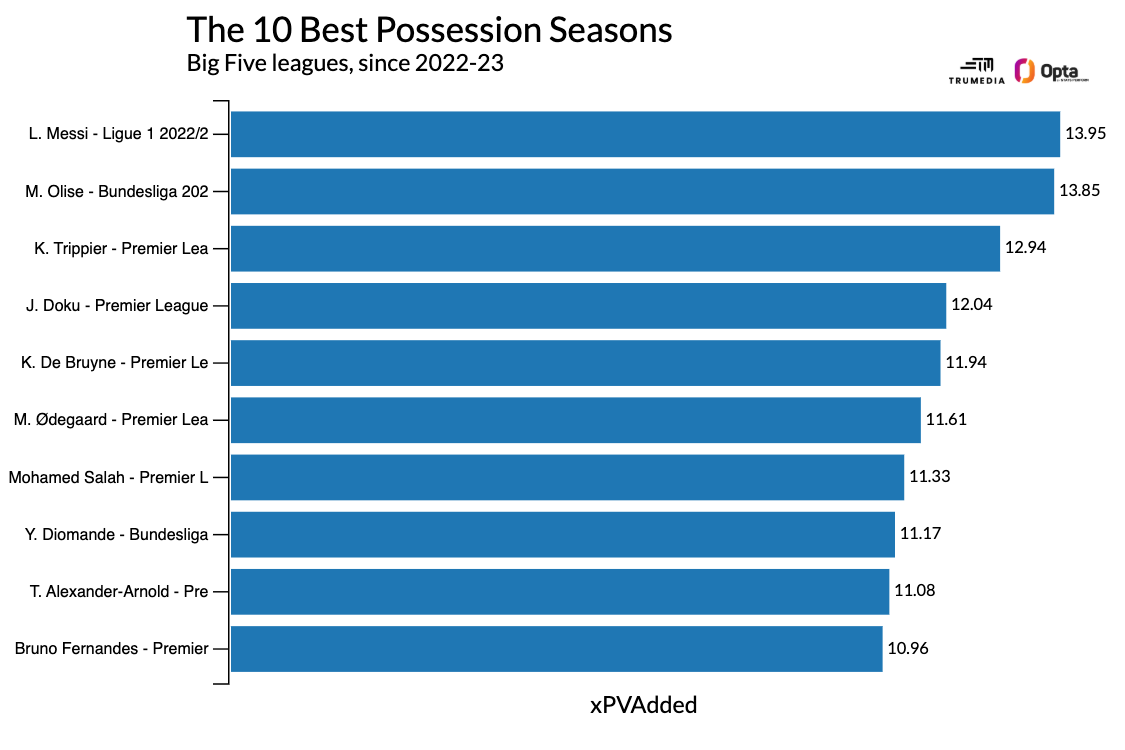
That's Lionel Messi with PSG in 2022-23, Michael Olise with Bayern last season, Kieran Trippier with Newcastle in 2022-23, Jérémy Doku with Man City last season, Kevin De Bruyne with Man City in 2022-23, Martin Ødegaard with Arsenal in 2023-24, Mohamed Salah with Liverpool in 2022-23, Yan Diomande with RB Leipzig last season, Trent Alexander-Arnold with Liverpool in 2022-23 and Bruno Fernandes with Manchester United last season.
The big difference between Diomande and everyone else on that list? He's 19, while the next-youngest players were 24. That's about as clear an indicator of future superstardom as you're going to get.
That's not to say there's not lots of risk associated with this move, though. Diomande has started only 34 professional domestic-league games across his career. And there's a long history of players lighting up the Bundesliga at a young age and then not being able to carry over their performance to a more competitive league such as the Premier League or LaLiga.
The €125 million Real Madrid spent to acquire Diomande is the highest fee they've ever paid for a player, but the specifics of the payment are largely meaningless for a team as rich as Madrid. Rather, it's the fit that's confusing.
When it seemed Madrid might be willing to part with Vinicius Junior earlier this summer, the move for Diomande made more sense. Lose perhaps the best ball-dominant, ball-carrying winger in the world and replace him with the next-best thing. But now that Vini is staying, the pieces don't fall together so nicely.
After all, the problem with Madrid over the past two seasons is that Vini and Mbappe don't make much sense together. Offensively, they both like to occupy the exact same spaces out on the left. And defensively, neither one is willing to press, so that both prevents Madrid from playing the preferred style of most top teams and it puts added defensive pressure on the eight other outfield players.
If Madrid are going to stick with the Mbappe-Vini pairing -- and they are, as they're now two of the three highest-paid players in the world, along with Manchester City's Erling Haaland -- then everyone else in the lineup has to fill in the gaps.
It's unclear how Diomande does that. He's not a bad defender, but you're not signing him to defend. (See: above graph.) And although he played on the right wing this past season, he is right-footed. And that seems to dictate how he plays.
When he played on the right for Leipzig, he took more touches overall but fewer inside the box. When he played on the left for Leipzig, he took fewer touches overall but more in the box. Basically, when on the right, he provided value in moving the ball up the field. And when on the left, he provided more value in finishing off moves inside the box.
If you have two attackers who already dominate the ball and drift out left, then a box-crashing winger makes sense as your third piece. But it doesn't make sense if he crashes the box only if he's playing on the same side that your other two attackers already occupy.
If Diomande is going to complement Mbappe and Vini properly, he's going to have to do something we still haven't really seen him do before.
All of Real Madrid's other summer signings: Why?
Sure, last season was disappointing for Real Madrid.
The team genuinely looked great for a month or so under Xabi Alonso, then the players revolted, the team stopped pressing and he got fired. Then things got worse as players literally fought each other in the locker room under interim manager -- and now somehow the manager at Fulham -- Alvaro Arbeloa.
In 19 games under Alonso, Madrid averaged an adjusted goal differential (70% expected goals, 30% goals) of plus-1.21 -- or basically what Barcelona averaged across the whole season. Under Arbeloa, that number slipped to plus-0.77.
That first half of the season was promising, and over the course of the entire campaign, Madrid were only the second-oldest team in LaLiga, after Barcelona. Madrid's average age, weighted by minutes played, was just 25.3. Add that to the fact that Bellingham and Arda Güler played only about half of the available minutes and Alexander-Arnold was featured only one-third of the time, and there were plenty of reasons to expect internal improvement.
So how do we explain four of Madrid's other major summer signings?
• Marc Cucurella: 28, fullback, €55 million from Chelsea
• Denzel Dumfries: 30, wingback, €20 million from Inter Milan
• Ibrahima Konaté: 27, center back, free agent from Liverpool
• Bernardo Silva: 31, midfielder, free agent from Manchester City
Though money doesn't really matter to Real Madrid, there is one way it does: They pay their players so much that it's hard to get them to leave if things don't work out. Silva is on only a two-year deal, but Konaté and Dumfries are signed through 2030, while Cucurella is locked up through 2032.
Neither Cucurella nor Dumfries has ever consistently played at a level where you'd be confident in saying either makes Real Madrid better. Silva absolutely would make Real Madrid better if still in his prime. And Konaté has alternated between looking like one of the best center backs in the world and a disaster waiting to happen.
Given their ages, these players are more likely to get worse at Real Madrid than get better.
And given Madrid's pursuit of Manchester City midfielder Rodri, who is 30, it seems like the club has responded to a couple of lean years by falling into the trap of "paying for proven talent." The problem with that is, more often than not, you're paying for what the players used to be. You acquire them right as age starts to take its toll.
Jose Mourinho: Why?
Given the recent departures of Pep Guardiola and Jurgen Klopp, the self-proclaimed Special One is the most famous current club manager in the world. But let's forget about that for a second.
Here are Mourinho's past 10 years as manager:
• Manchester United (2016-18): Finished sixth in Year 1 and won the Europa League, finished second in Year 2, was fired midway through Year 3.
• Tottenham (2019-21): Never managed a full season, but the team finished sixth and seventh in his two partial seasons with the club.
• Roma (2021-2024): Finished sixth in Serie A in his first two seasons, won the UEFA Conference League in Year 1, reached and lost in the UEFA Europa League final in Year 2, was fired midway through his third season.
• Fenerbahce (2024-25): Finished second in his first season, was fired at the beginning of his second season after losing to Benfica in a Champions League playoff qualification tie.
• Benfica (2025-26): Went undefeated in the Portuguese league but finished third and missed Champions League qualification.
I lay all of this out because when your main achievement over the past decade is "won Europe's lower-tier continental competitions," that's usually not enough to get anywhere near the head coaching job at a club such as Real Madrid.
So, the only way that the Mourinho signing makes any sense is when you add his fame into the picture. And once you do that, it's hard not to look at this current summer as anything other than this: Florentino Perez and Real Madrid are reverting to how they used to do things.
Madrid's most successful managers have been player-coaches such as Carlo Ancelotti and Zinedine Zidane, who both found a way to cram enough superstars onto the field at the same time in order to keep everyone happy. Mourinho, who criticized Vinicius Junior after the Brazilian was racially abused by one of Mourinho's Benfica players, is the exact opposite of that. He has already started criticizing Bernardo Silva just a week after he joined the team.
Perhaps more importantly to Perez, Mourinho is the opposite of what Barcelona currently are.
Under manager Hansi Flick, Madrid's biggest rivals don't really care about giving up goals because they're able to score them for fun. Barcelona defend as aggressively as any top team we've ever seen -- they've drawn only five total games over the past two full seasons. Meanwhile, Mourinho's more recent teams have been much better at not losing than actually winning. Across his past three jobs, his teams have drawn 22% of their matches.
What Mourinho represents seems to be more important than what he actually might mean for the team's success.
This, of course, is not to say it can't work out. In a "bad" year, Madrid won 86 points, easily beat Manchester City in the Champions League and gave up the fewest goals in LaLiga.
Per Transfermarkt, Real Madrid have the second-most valuable squad in the world, after Manchester City. And if we look at only the top 18 players on the team, they're still second -- this time behind PSG. There is enough talent on this Real Madrid team to win every major trophy.
Real Madrid's roster still has a ton of upside, but after this summer, the downside is bigger than it has been in a long time. Their two superstars still haven't figured out how to play together. Their new club-record signing has played elite soccer for one total season and looks like an uncomfortable fit with that pairing, too. The rest of their summer signings are old, unspectacular or both.
And they've decided to hand the keys to a coach who hasn't managed an elite team in over a decade, tends to err conservatively in his personnel decisions, and has a long history of feuding with his own players and blowing everything up before his contact reaches its end.
What could go wrong?